
What Is AI Memory? How ChatGPT, Claude, and Gemini Remember You (2026)
Ask ChatGPT to "remember" that you prefer Python over JavaScript, and it will cheerfully agree. Ask Claude to recall a detail from a conversation three weeks ago, and it will sometimes surface exactly that detail. In 2026, "AI memory" has become a standard feature on every major assistant.
But scratch the surface and you'll find something stranger than the UI suggests. Memory in AI is not one thing. It's four different technical layers stacked on top of each other, each doing a completely different job. When users say "the AI remembered me," they're usually talking about the thinnest and newest layer of all — a layer that was invented barely eighteen months ago.
This article is a deeper look at what's actually happening under the word "memory" when you talk to ChatGPT, Claude, or Gemini. It's not a product comparison (that's here), and it's not a migration tutorial (that's here). It's an attempt to give you a clean mental model of what's real, what's illusion, and where the whole field is heading.
The Strange Word "Memory"
The word "memory" is borrowed from human psychology. When a human remembers something, a physical trace in the brain is being retrieved, consolidated, and sometimes re-encoded. Memory is inseparable from learning — remembering is a form of learning.
Large language models do none of this. An LLM's weights — the billions of numbers that define its behavior — are frozen the moment training ends. When you say "remember that I prefer Python," the weights don't change. Nothing inside the model updates. Every user interacting with ChatGPT today is talking to the exact same set of numbers, character for character.
So how does the AI "remember" anything? The answer is: it doesn't. It simulates memory by quietly loading relevant content into the prompt each time you send a message. What looks like memory is really a well-orchestrated retrieval-and-injection trick, sitting on top of a model that has no memory of its own.
Once you understand this, the strangeness of AI memory starts to make sense. Everything that feels like memory is actually one of four different mechanisms doing a lookup and pasting the result into your prompt before the model ever sees it.
Baseline: LLMs Without Memory
Before we can talk about AI memory, it helps to start from the baseline: LLMs have no inherent memory at all.
Here's what that means concretely. Suppose you open a fresh ChatGPT chat and say "Hi, my name is Alex." The model reads your message, generates a response ("Hi Alex, how can I help?"), and then the moment that response is delivered, the model forgets. Not in the way humans forget — there's literally nothing persistent that was changed. The model's weights are the same as they were five seconds ago. There's no internal state that carries forward.
If you then start a brand new chat and say "What's my name?" the model will honestly tell you it doesn't know. Because it doesn't. The previous session left no trace inside the model.
This is counterintuitive because conversations feel personal. You chat with ChatGPT, it responds thoughtfully, it seems to follow along — it feels like there's someone on the other end who is aware you're talking. But there isn't. The model is a pure function: it takes input (your message plus anything else the system decides to inject) and produces output. No internal memory, no carried state, nothing that accumulates over time.
Every form of "memory" you see on top of this baseline is a workaround — a way for the system around the model to fake persistence by injecting the right content at the right time.
The Four Layers of AI Memory
Modern AI assistants simulate memory through four distinct technical layers, each with different properties, costs, and limitations. Users mix them up constantly, but it's worth understanding them separately because they behave so differently.
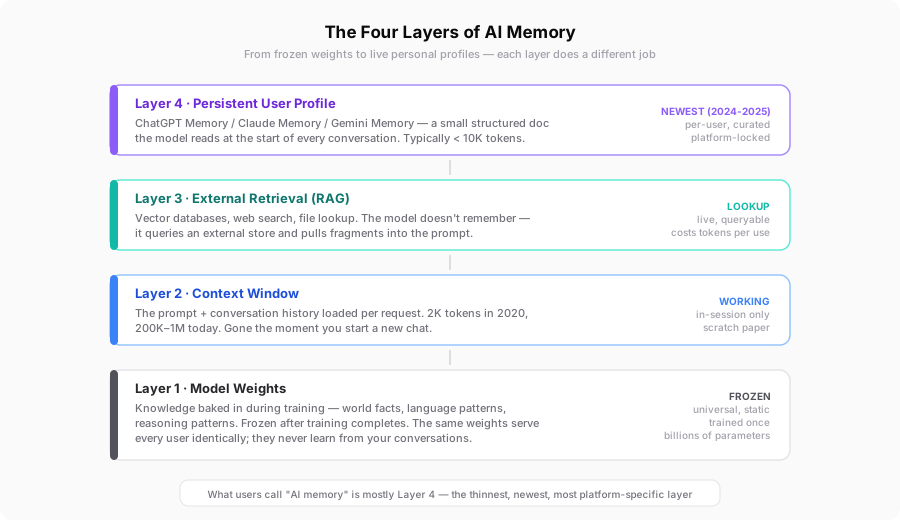
Let's go through them from the bottom up.
Layer 1: Model Weights (The Frozen Foundation)
The lowest layer is the model itself — billions of numerical parameters set during training. This is where the model's general knowledge lives: facts about the world, language patterns, reasoning abilities, coding conventions, historical events up to the training cutoff.
Everything the model "knows" without being told lives here. When ChatGPT can tell you about the French Revolution or debug a Python stack trace, it's drawing on this layer.
Three properties are critical to understand:
Frozen after training. Once training ends, these weights don't change during normal use. Your conversations don't update them. No matter how many times you correct ChatGPT or tell it your preferences, the underlying model stays identical.
Universal across users. Every user of GPT-5 is talking to the same set of weights. There is no "your version" of the model. The only thing that differs user-to-user is what's in the prompt.
Out of reach for end users. The only way to change this layer is to fine-tune the model on new data, which is expensive, slow, and reserved for providers. As an end user, you have zero access to Layer 1.
This is the layer most often confused with "memory." People say things like "ChatGPT remembers how Python works" or "GPT-4 remembers history." But that's not memory — that's knowledge, baked in during training, universal to every user, and completely static. It would be more accurate to call it "what the model has learned" rather than "what the model remembers."
Layer 2: Context Window (Working Memory, This Session)
The next layer up is the context window — the prompt and conversation history loaded into the model for each request. This is where anything the model "knows about you" right now has to live.
Context windows have grown explosively. In 2020, GPT-3 handled about 2,000 tokens (roughly 1,500 words) per request. In 2026, Claude handles 200K tokens, Gemini pushes past 1 million for some models. That's enough to fit an entire book into a single conversation.
Within a session, the context window feels like memory. You tell ChatGPT "my name is Alex" in turn 1, and in turn 20 it still calls you Alex. That's not because the model remembered — it's because the system is re-sending the entire conversation history with every new message. The model sees all 20 turns at once, processes them, generates turn 21, and then the whole thing dissolves.
Two critical limits:
It's gone when the session ends. Start a new chat, and the context window is empty. There is no link from one conversation to the next.
It has a hard cap. Even within one session, if you exceed the token limit, older turns are dropped. You might notice this in very long conversations when the model suddenly "forgets" something you said earlier — it didn't forget; the older content literally stopped being sent with your message.
Calling the context window "memory" is technically misleading. It's closer to working memory — the temporary holding space where you keep numbers in mind while doing arithmetic. Except your brain's working memory fades naturally over seconds. The context window doesn't fade; it's surgically removed the moment the session ends.
Layer 3: External Retrieval (RAG) — The Reference Library
Layer 3 is where things get more interesting. Retrieval-Augmented Generation, or RAG, is the technique of giving the model access to an external database it can query before answering.
The model doesn't "remember" anything in this layer either — but it can look things up. When you ask ChatGPT to search the web, it's using RAG: the system finds relevant pages, extracts content, and pastes that content into your context window before the model generates its response. Same story when ChatGPT "reads" a PDF you uploaded, or when Claude searches your past conversation history.
Under the hood, RAG usually works through vector embeddings. Each document (or chunk of a document) is converted into a numerical fingerprint that captures its meaning. When you ask a question, your question is also embedded, and the system finds documents whose fingerprints are closest in high-dimensional space. Those get pulled into your context.
RAG changed what AI assistants can do. Without it, models are stuck with whatever was in their training data — outdated, general, often missing specifics. With it, they can cite last week's news, reference your company wiki, or quote a paragraph from page 87 of a 400-page manual.
But RAG has its own character. It's pull-based, not push-based: the model has to decide (or be configured) to look something up for a specific request. It doesn't accumulate a personal sense of you. Every query is a fresh trip to the reference library. It also costs tokens, because retrieved content has to fit in the context window alongside your conversation.
Most people don't think of RAG as "memory" — and in one sense they're right, because nothing persists about them. But in another sense, RAG is exactly what memory is for a brain: a way to pull the right information into active processing at the right time. Human memory is basically biological RAG.
Layer 4: Persistent User Profile (The Personal Manual)
The top layer is the newest and thinnest — and it's what most users actually mean when they say "AI memory."
ChatGPT Memory, Claude Memory, and Gemini Memory all implement the same rough idea: store a small structured document about each user, and prepend it to the prompt every time that user starts a new conversation. The document typically contains a few thousand tokens at most — enough to capture preferences, projects, skills, and recurring instructions, but a tiny fraction of what the context window can hold.
Mechanically, it works like this: when you send a message, the system reads your personal profile, prepends it to your message, and only then passes it to the model. The model sees something like:
[SYSTEM: User is a frontend developer. Prefers TypeScript.
Currently working on a Chrome extension for AI memory.
Always responds in concise bullet points when asked.]

User: Help me debug this promise chain...
The model doesn't know this profile exists in any special way. It just reads it as more context. From the model's perspective, it's just more of the prompt. But because the profile travels with you across sessions, it creates the experience of the AI "remembering" you even though nothing inside the model has changed.
Persistent profiles are powerful because they're cheap. They fit in a few thousand tokens, they don't require retraining the model, and they can be edited or deleted. They're also the easiest layer to understand because they map clearly to the intuitive notion of "things the AI knows about me."
But the tradeoffs are real. The profile can't hold everything — it's a summary, not a log. It lives inside one platform and doesn't transfer easily (we covered this in detail in our platform comparison). And because it's just a bit of text prepended to every prompt, it competes with your actual conversation for token budget.
Why "Memory" Is a Misnomer
Put the four layers together and you can see why "AI memory" is a slippery phrase.
Layer 1 is knowledge, not memory. Layer 2 is working memory, but only in the narrowest sense — it's really just the prompt. Layer 3 is retrieval from an external store. Layer 4 is a stored profile that gets prepended every time.
None of them match what humans mean by memory. When you remember your grandmother's face, you're doing something that involves encoding, consolidation, emotional weighting, reconstruction — an active biological process. When ChatGPT "remembers" that you prefer Python, it's reading a line of text that was added to your profile at some earlier point and is being silently prepended to your current prompt.
One way to put it: AI doesn't have memory, it has selective re-exposure. Every "memory" the AI appears to have is actually a fragment of text that was selected (by some retrieval mechanism) and injected into the context window of the current request. There is no continuous subjective experience of remembering. There are only text fragments being assembled in the right order.
This isn't a criticism — the technique works beautifully for most practical purposes. But it matters when you start bumping into the edges, because those edges are where the illusion breaks down.
Human Memory vs AI Memory
A quick comparison makes the differences concrete.
| Dimension | Human Memory | AI Memory (Layer 4) |
|---|---|---|
| Encoding | Automatic during experience; shaped by attention and emotion | Explicit — something has to decide "this is worth storing" |
| Consolidation | Happens overnight and over years; memories mature and change | None. A stored fact stays the same until explicitly updated |
| Retrieval | Associative and reconstructive — cues trigger related memories | Keyword / embedding match; everything in the profile is always available |
| Forgetting | Gradual, adaptive — lets go of irrelevant details over time | Binary — either manually deleted or remembered forever |
| Emotional weight | Deeply emotional; important events become clearer, not fainter | Flat — "my mother died" and "I like salad" weigh the same |
| Continuity | One unified self across all contexts | Locked per platform; you have one "self" in ChatGPT, another in Claude |
The most interesting row might be forgetting. Human memory forgets strategically — old irrelevant things fade, while important things are re-consolidated each time you recall them and grow stronger. AI memory has no such mechanism. An old preference you mentioned once in 2024 is still there in 2026, taking up the same token budget as something you said yesterday, unless you manually delete it.
What AI Memory Still Can't Do
Knowing the four layers helps explain some of the things that feel frustrating about AI memory today.
It can't consolidate. If you tell ChatGPT in January that you use Vue, and in April you've switched to React, both facts will sit in your profile unless you explicitly delete the old one. A human would gradually update — the new use case would reshape the memory of the old. AI memory just accumulates until you prune it.
It can't weigh importance. There's no way to tell Claude "this is important, remember it forever" versus "this is a passing preference, feel free to forget it." Everything in the profile has the same weight. Over time, important things get lost in noise.
It can't contextualize when to apply. The profile is prepended to every prompt, for every kind of task. If you told ChatGPT you're a vegetarian when asking about recipes, that memory will also be injected when you ask it to debug Python code, quietly costing you tokens and maybe affecting the response in subtle ways.
It can't travel. Each platform locks its own memory in. A profile you build up in ChatGPT stays in ChatGPT. Claude and Gemini now support one-way imports via copy-paste prompts (see our guide), but it's a manual, lossy process. There is no cross-platform memory standard.
It can't forget gracefully. The only way memories leave is deletion. There's no concept of "this was relevant then but isn't now." Stale memories just keep accumulating until you manually clean them out.
These aren't bugs in any particular platform. They're consequences of how Layer 4 is implemented: a flat text document prepended to every prompt. Fixing any of them would require a fundamentally different architecture.
Where AI Memory Is Going
Several research directions are trying to get past these limits.
True long-term memory architectures. Research from DeepMind, Meta, and academic labs is exploring models that can learn continuously without catastrophic forgetting (the tendency of neural networks to overwrite old knowledge when trained on new data). If this works, the model itself — not a text profile prepended to prompts — could accumulate memories over time. This would be the first real bridge between Layer 1 and Layer 4.
Memory compression and consolidation. Instead of a flat profile, imagine a memory system that periodically re-summarizes what it knows about you, collapsing redundant entries, updating stale ones, and emphasizing important ones. Some startups are experimenting with this kind of "memory gardening," though it's still early.
Hybrid retrieval. Blending Layer 3 (RAG) and Layer 4 (persistent profile) so the profile is small and stable while a vector store holds the long tail. Your request triggers a semantic lookup against your full conversation history, pulling only the most relevant pieces into context. This is closer to how human memory actually works.
On-device memory. Running the memory layer locally on your device instead of in the cloud, for privacy and latency. The model is still in the cloud, but everything it knows about you stays on your machine. This is increasingly important as personal context becomes more sensitive.
Cross-platform standards. The missing piece. No one has yet proposed a clean, open format for AI memories that works across ChatGPT, Claude, Gemini, and whatever comes next. Without a standard, every user is locked into the silo of whichever assistant they use first. This is the problem I decided to start tackling with MemoryX — a browser-side memory layer that sits outside any single platform.
Takeaways
- AI memory isn't one thing. It's four distinct layers — model weights, context window, external retrieval, and persistent profile — doing different jobs.
- LLMs don't actually remember. They simulate memory by loading selected content into every prompt. The model itself never learns from your conversations.
- What you think of as "ChatGPT remembering you" is Layer 4 — a small structured profile prepended to every request. It's the newest and thinnest layer.
- AI memory today can't consolidate, weight, contextualize, travel, or forget gracefully. These are architectural limits, not bugs.
- The research frontier is trying to fix this — through long-term memory architectures, memory compression, hybrid retrieval, and cross-platform standards.
The practical implication for anyone using AI seriously in 2026: don't treat AI memory as a black box. Understand which layer you're relying on, accept its limits, and be deliberate about what you put there. The future will bring better memory architectures, but the mental model in this article — the four layers, the gap between simulation and true memory, the platform silos — will remain useful for years.
If you're already feeling the pain of platform-locked memory, the rest of the MemoryX blog is worth a read: the ChatGPT vs Claude vs Gemini deep comparison, how to manually migrate memories between them, and how MemoryX implements cross-platform memory technically.
MemoryX is a Chrome extension that creates a unified memory layer across ChatGPT, Claude, and Gemini — an experiment in what AI memory could look like when it's not locked inside a single platform. Install it from the Chrome Web Store.
Tired of your AI forgetting you?
MemoryX is a browser-side memory layer that travels with you across ChatGPT, Claude, and Gemini.
Install from Chrome Web Store